Tankless Impulse Toilet: How It Works and What Pressure It Needs
An impulse toilet has no tank: flush water comes straight from the water supply. It's convenient, but it only works with good water pressure — here's how to check it in 15 seconds and when a model with a tank is the better choice.
· 8 min read
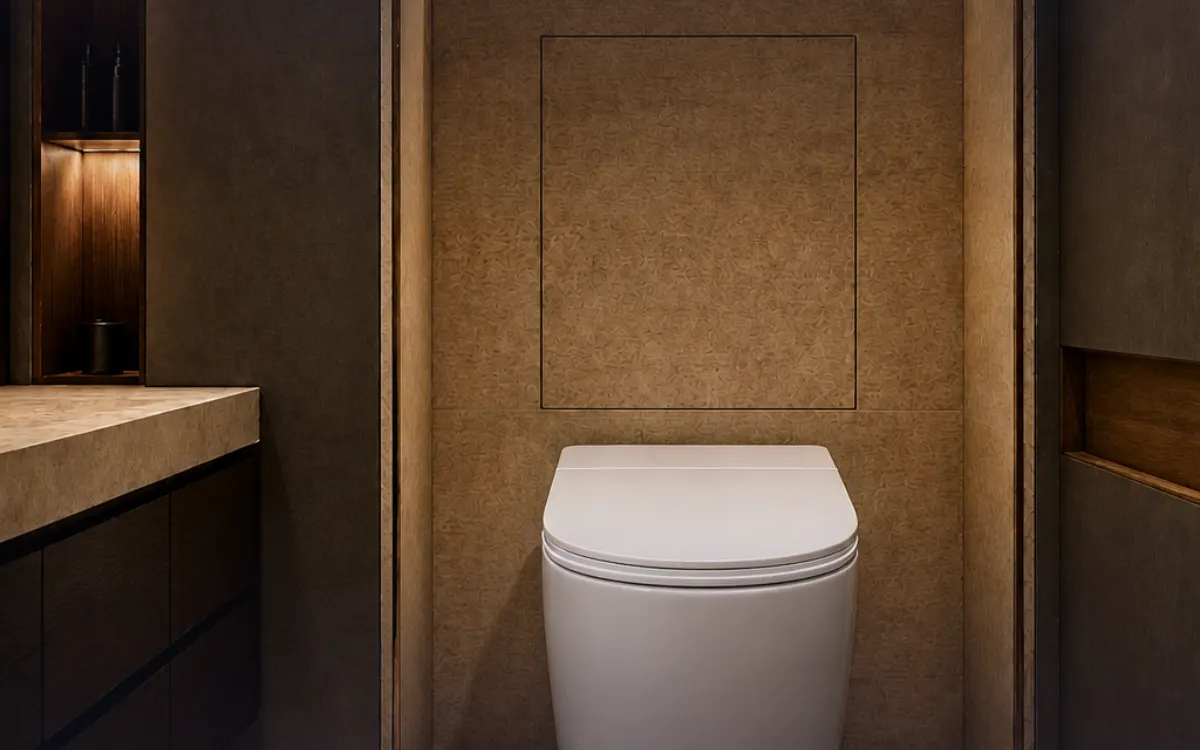
What is an impulse toilet
An impulse toilet is a tankless toilet with an impulse flush. Instead of a tank that fills up between flushes, it has a valve. When you flush, the valve opens for a short moment — an “impulse” — and lets water into the bowl straight from the water supply.
Impulse flushing is found on both regular and smart toilets. “Tankless toilet”, “toilet without a cistern”, “toilet with an impulse flush” — these are all names for the same device. In a smart toilet, the flush is triggered by a button, a voice command or automatically when you step away from the toilet.
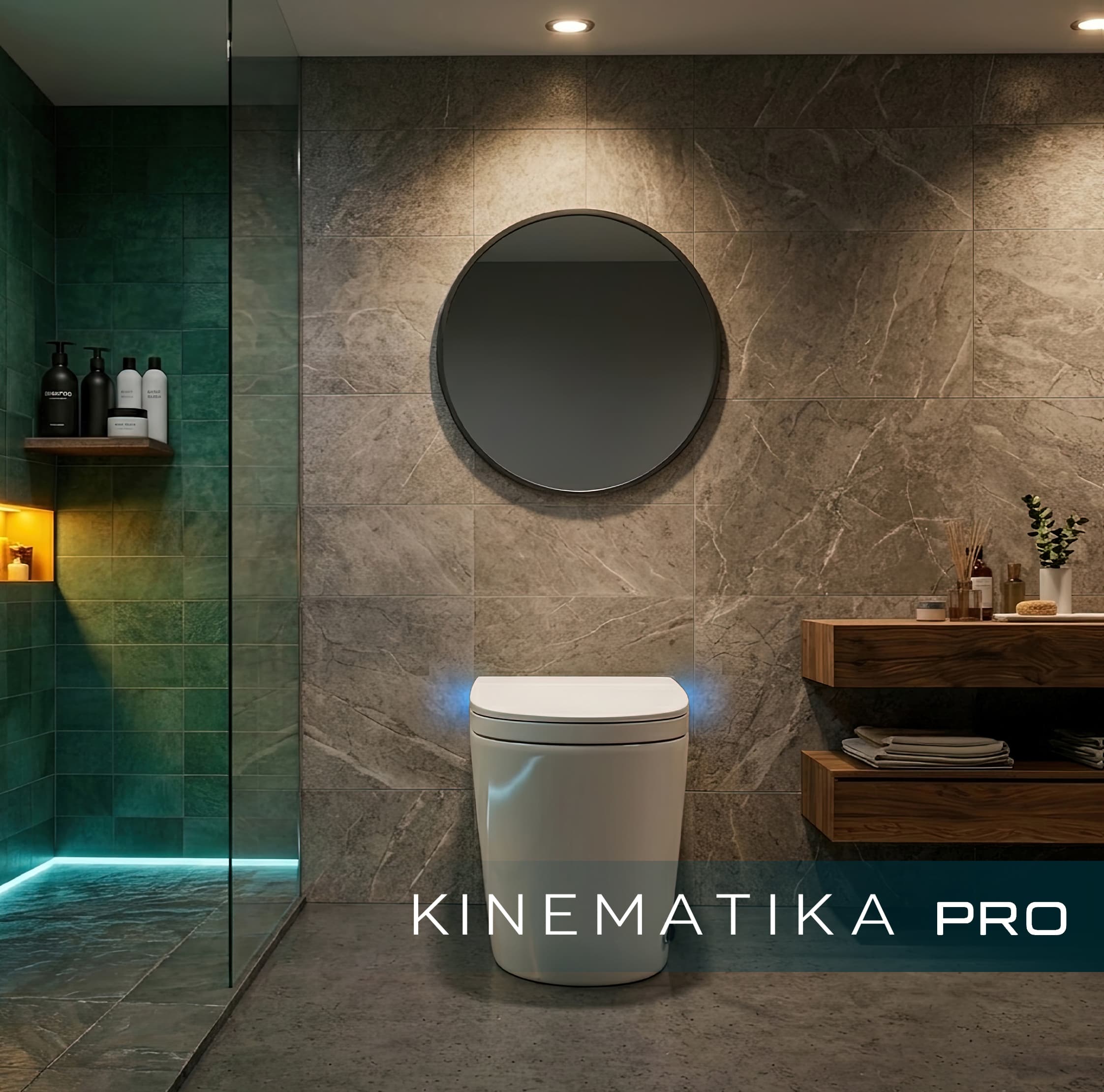
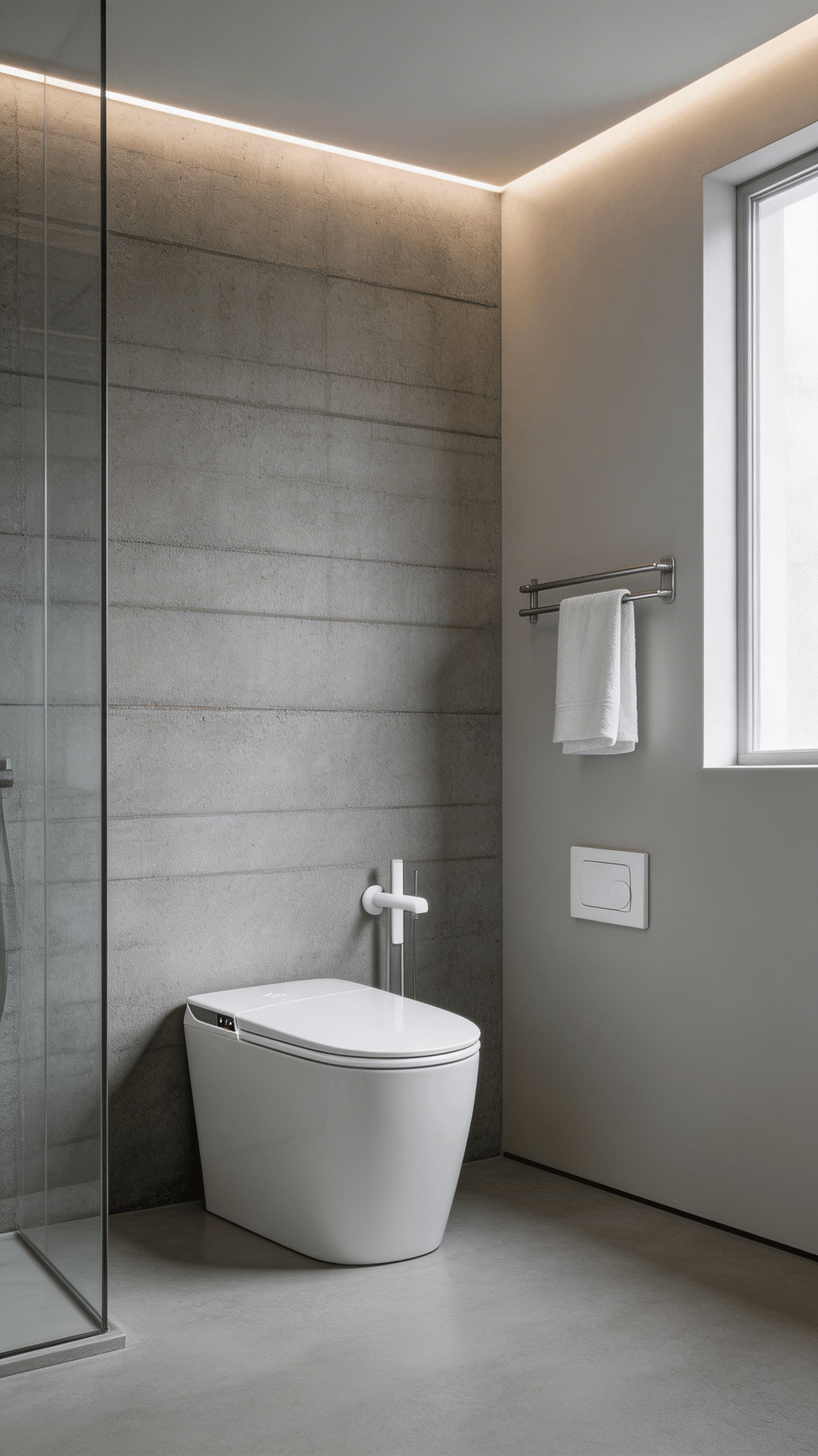
In the Kinematika Pro range, the tankless models are the floor-standing O series without the letter B: O92, O92F, O93, O93F and O24. They're all gathered in our selection of tankless smart toilets.
How an impulse toilet works
The way an impulse toilet works comes down to four steps:
- You press the button, say “Flush” or simply walk away — the auto flush kicks in.
- The electronics open the valve.
- Water from the mains flows into the bowl under pressure and swirls in the Tornado flush.
- The valve closes. There's no tank, so there's no waiting for it to refill.
Hence the main rule: an impulse toilet has no water reserve. Flush strength depends on how much water the plumbing delivers at the moment of flushing. If the flow is weak, the water doesn't have time to rinse the bowl, and it seems the toilet flushes poorly. Most often the problem isn't the toilet but the supply line.
What water pressure a tankless toilet needs
The most common mistake is looking at pressure in bar. It doesn't show how much water will actually reach the toilet. Even at 10 bar, hose transitions of 3/4 → 1/2 → 3/4 sharply reduce the flow. A tankless toilet needs good flow pressure — enough water per minute, not high pressure.
Flow test with a 5-liter bottle
- Take an empty 5-liter bottle.
- Hold it under the hose that will feed the toilet — not under a nearby tap.
- Run the water for 15 seconds.
- See how much has collected.
If you collected 4.5 liters or more — about 18 liters per minute — the flush will work. If less, go for a model with a tank.
Why this particular test? A bottle and a stopwatch measure what matters to a tankless toilet: how much water the supply line delivers per unit of time. A pressure gauge shows the pressure in the pipe but doesn't see bottlenecks along the way. A bottle held under that very hose accounts for all the adapters and narrowings at once.
Check the flow when water use in the building is at its peak, for example in the morning. If the pressure fluctuates, a model with a tank is more reliable: its flush won't depend on it.
What to do if the flow isn't enough
- Inspect the toilet's supply line. Transitions from a wide hose to a narrow one and back, as well as extra adapters, reduce the flow. They can be removed — ask a plumber for advice.
- Repeat the bottle test after the changes.
- If it's still under 4.5 liters in 15 seconds, choose a model with a tank. It has the same wall drain outlet and bidet modes: O92B is the counterpart of O92, and O93B of O93.
If you've already bought a tankless model but haven't installed or used it yet, you can return it within 14 days of receipt, provided it's in its original condition and packaging.
Impulse toilet: pros and cons
| Tankless (impulse valve) | With a built-in tank | |
|---|---|---|
| Where flush water comes from | Straight from the water supply | From the tank, which refills between flushes |
| Required water pressure | Good flow pressure | Any, including weak or fluctuating |
| Repeat flush | No waiting for the tank to refill | The tank needs time to refill |
| Floor drain outlet | Yes: O92F, O93F | Not in our online catalog: models with a tank have a wall drain |
| Kinematika Pro models | O92, O92F, O93, O93F, O24 | O92B, O93B and all wall-hung D-series models |
Pros of an impulse toilet:
- The flush doesn't wait for a tank to refill — you can repeat it right away.
- If your drain comes out of the floor, the tankless O92F and O93F from our online catalog will fit.
Cons of an impulse toilet:
- Dependence on water pressure: with weak flow, the flush will be weak.
- Narrowings and adapters on the supply line “eat up” the flow, even when the pressure is high.
- If the pressure in the building fluctuates, the flush may be uneven.
Price isn't the deciding factor here: O92 and O92B are priced the same, and so are O93 and O93B — current prices are in the catalog. Choosing between a tank and an impulse valve means choosing for your plumbing, not your budget.
When a smart toilet with a tank is the better choice
- The bottle test showed less than 4.5 liters in 15 seconds.
- The water pressure in your apartment or house is weak or fluctuates.
- You're installing a wall-hung toilet on an in-wall frame — all our wall-hung models have a built-in tank.
Floor-standing models with a tank are ACCELERATION O92B and MOMENT O93B. Wall-hung D-series models have a built-in 5.3-liter tank and flush at any pressure — see our selection of wall-hung smart toilets. All models with a tank are gathered in our selection of smart toilets with a tank.
Kinematika Pro tankless smart toilets
| Model | Drain outlet | What sets it apart | Price |
|---|---|---|---|
| ACCELERATION O92 | Into the wall | Hot-and-cold massage | In the catalog |
| ACCELERATION O92F | Into the floor | Hot-and-cold massage | In the catalog |
| MOMENT O93 | Into the wall | Feminine wash | In the catalog |
| MOMENT O93F | Into the floor | Feminine wash | In the catalog |
| INERTIA O24 | Into the wall | Entry-level model, being discontinued; 680 × 400 × 480 mm | In the catalog |
All of them have a bidet with a self-cleaning nozzle, UV sterilization, seat and water heating, a warm-air dryer, auto lid and auto flush, Foam Shield and voice control in Russian. That's what an impulse toilet with a bidet is: no tank, but every smart feature.
How to choose between them: O92 and O92F are for those who want a hot-and-cold massage, O93 and O93F for those who need a feminine wash. The letter F means a floor drain outlet; without it, the drain goes into the wall. Any floor-standing O-series model can be fitted with a black panel, a decorative cover. To see what a floor-standing model looks like and how it works, watch the ACCELERATION 092 review.
Installation is the same as for a regular floor-standing toilet: a water supply and a 220 V outlet nearby. Step by step — in our article how to install a smart toilet, and if you're unsure which to choose — in our guide how to choose a smart toilet.
Models in this article

Questions and answers
How does an impulse toilet work?
Instead of a tank, it has a valve. When you flush, the valve opens briefly and lets water into the bowl straight from the water supply.
What water pressure does a tankless toilet need?
Good flow pressure: an empty 5-liter bottle filled from the supply hose should collect 4.5 liters in 15 seconds — about 18 liters per minute. Pressure in bar doesn't tell you this.
Why does an impulse toilet flush poorly?
Most often there isn't enough flow: narrowings in the supply line get in the way, or the pressure drops. Check the flow with a bottle — if it's under 4.5 liters in 15 seconds, you need a model with a tank or a different supply line.
Which is better: a toilet with a tank or an impulse one?
With good, stable pressure, both will do. If the pressure is weak or fluctuates, a model with a tank is more reliable: its flush won't depend on it.
Is there an impulse toilet with a floor drain outlet?
Yes, at Kinematika Pro these are ACCELERATION O92F and MOMENT O93F — both tankless.